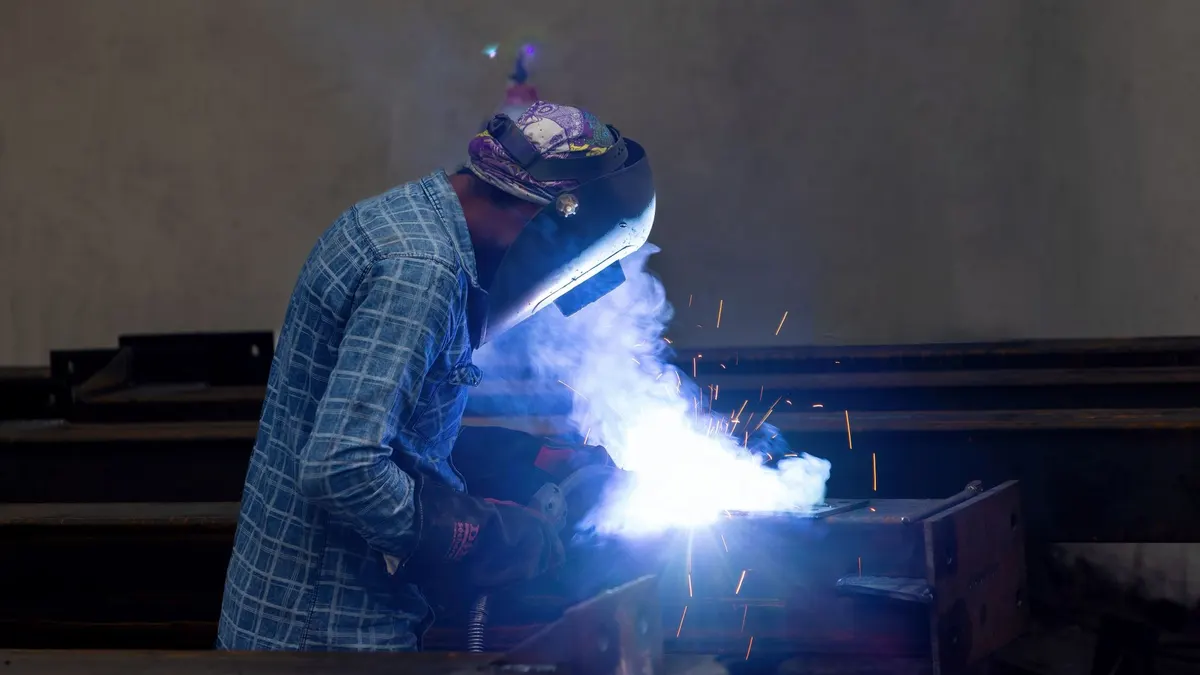
Is Welding a Good Career?
For many people, yes. BLS projects about 40,300 welder openings a year from 2025 to 2035, and welders earned a median of $53,750 in May 2025, with the top tenth above $77,530. The catch is growth: welding employment is projected to rise only 2.4%, from 437,700 to 448,100 jobs, so most openings come from replacing workers who leave. Moving into supervision, ironwork or millwright work raises the pay ceiling.
Welding is a good career if you want steady work, a paycheck you can live on without a four-year degree, and skills that carry across industries. It is a weaker bet if you are counting on a booming job market. The federal numbers show both sides clearly, so here they are, side by side.
Three Numbers That Answer the Question
40,300 openings a year. That is how many welder, cutter, solderer and brazer jobs BLS expects to open each year from 2025 to 2035. It is a large number for a trade you can enter in under a year.
$53,750 median pay. Half of the 416,210 welders counted in May 2025 earned more than this, half less. That works out to $25.84 an hour.
2.4% growth over ten years. Employment is projected to go from 437,700 in 2025 to 448,100 in 2035. That is slow. Most of those 40,300 yearly openings will come from welders who retire or move into other work, not from new jobs.
Put together: there is steady hiring, but you are mostly stepping into someone else’s spot.
The Pay Spread, From First Job to Top Earners
The median hides a wide range. Here is how welder pay was spread in May 2025, according to BLS.
| Where you sit | Yearly pay |
|---|---|
| Bottom tenth | Under $39,240 |
| Bottom quarter | Under $46,790 |
| Median | $53,750 |
| Top quarter | Over $63,010 |
| Top tenth | Over $77,530 |
New welders usually start near the bottom of this table. The jump from $39,240 to $77,530 is roughly double, and it comes from skills (pipe, TIG, code certification), location and overtime. The welder salary page breaks this down by state, and the welder career guide covers the work day to day.
Where Growth Is Flat or Falling
A balanced answer has to include the parts of the field that aren’t growing. BLS projections for 2025 to 2035:
| Occupation | Change, 2025–35 | Openings a year |
|---|---|---|
| Welders, cutters, solderers and brazers | 2.4% | 40,300 |
| Welding machine setters and operators | -8.9% | 2,500 |
| Boilermakers | -1.8% | 700 |
| Postsecondary career and technical teachers | -0.3% | 8,000 |
| Construction and building inspectors | 0% | 14,800 |
| Millwrights | 0.9% | 3,200 |
| First-line production supervisors | 1.8% | 61,000 |
| Structural iron and steel workers | 3.1% | 5,900 |
| Commercial divers | 4.8% | 400 |
| Plumbers, pipefitters and steamfitters | 6.8% | 42,000 |
| Materials engineers | 7.5% | 1,300 |
The warning sign is the second row. Jobs tending welding machines are projected to shrink 8.9%, the steepest drop in the table. If you want a career that lasts, learn the manual processes used in pipe, structural and repair work, and consider learning to set up and program welding robots too. The robotic welding technician page covers that path; those technicians earned a median of $47,920 in May 2025.
Boilermaking, construction inspection and teaching are flat. They still hire, because people retire, but don’t expect expansion. Construction and building inspectors, for example, are projected to hold at 153,900 jobs in both 2025 and 2035, yet BLS still expects 14,800 openings a year as people leave the field. Flat is not the same as closed.
The bright spots are pipe-related. Plumbers, pipefitters and steamfitters are projected to grow 6.8% with 42,000 openings a year, so pipe welding skills travel well. See the pipe welder career page.
Careers That Raise Your Ceiling
Welding works best as a starting point. These related careers paid more than the welder median in May 2025:
- Welding supervisor: $74,450 median. BLS lists a high school diploma plus some work experience. With 61,000 openings a year across production supervision, this is the most common step up.
- Millwright: $65,700 median, usually through an apprenticeship.
- Ironworker: $62,780 median, with the top tenth above $108,260. Usually through an apprenticeship.
- Welding instructor: $63,820 median for postsecondary career and technical teachers.
- Welding engineer: $122,930 median, but it typically needs a bachelor’s degree.
One career pays less than you might expect: welding inspectors are grouped by BLS with all inspectors and testers, whose median was $48,570. Inspection still rewards experience, but the national figure for the whole group is below the welder median. See welding inspector for details.
The Honest Downsides
- Slow job growth. You are competing for replacement openings, not riding an expansion.
- The pay floor is modest. A tenth of welders earned under $39,240 in May 2025. Your first year may look like that.
- Automation pressure. Machine-operator jobs are shrinking fastest, so pure production-line work is the riskiest place to stay.
- The work is physical. Welding is hands-on shop or field work, often in heat, awkward positions and protective gear.
None of these rule welding out. They are reasons to pick training that includes more than one process and a path toward pipe, structural or supervisory work.
Who Welding Suits, and Who It Doesn’t
Welding tends to reward a particular kind of person. Be honest with yourself about which list sounds more like you.
It suits you if:
- You like working with your hands and seeing a finished piece at the end of the day.
- You want to earn a living wage without four years of college. BLS lists a high school diploma as the typical entry education, followed by moderate-term on-the-job training.
- You are willing to keep learning. The welders in the top quarter, above $63,010, usually add processes, pass code tests or move into pipe and structural work.
- You are open to moving or traveling for work, since shop, field and plant jobs are spread across many industries.
Think twice if:
- You need a high salary from year one. A tenth of welders earned under $39,240.
- You want a desk job eventually but don’t plan to go back to school. The highest-paying related roles, welding engineer and welding sales representative, typically need a bachelor’s degree.
- You would be happy staying on one production line indefinitely. That is the part of the field most exposed to automation.
What It Takes to Get in
The entry cost is low compared with most careers that pay this well. A full-time year at a public college often costs a few thousand dollars in tuition and fees. For 2024–25, San Jacinto College charged $2,490 in-district, Central Georgia Technical College $3,448 in-state and Ivy Tech Community College $5,154 in-state.
Time is short, too. Private career schools such as Tulsa Welding School run a 7-month diploma, and many community colleges offer one-semester or one-year certificates. An associate degree takes about two years and keeps the door open to supervision, inspection and teaching.
After training, most employers will ask you to pass a weld test. That test, not the diploma, is what gets you hired on many job sites, so choose a program that prepares you for code testing.
Where to Train if You Decide to Go for It
Some of the busiest welding programs, by welding awards conferred in 2024–25:
- Tulsa Welding School in Houston: 1,087 awards, with a 7-month Professional Welder diploma.
- Ivy Tech Community College in Indiana: 779 awards, with certificates that stack into an associate degree.
- Maysville Community and Technical College in Kentucky: 754 awards, including pipeline welding certificates.
- Central Georgia Technical College in Macon: 546 awards across a diploma and short certificates.
- San Jacinto College near Houston: 534 awards.
For a school closer to home, start with your state: Texas, Kentucky, Indiana, Georgia or Ohio, or browse every welding school. Not sure how much training you need? Read how long welding school takes and welding certificate vs associate degree, then see how welding certification works.
Frequently Asked Questions
Do Welders Make Good Money?
The median welder earned $53,750 in May 2025, or $25.84 an hour. The middle half earned between $46,790 and $63,010, and the top tenth earned more than $77,530, according to BLS.
Will Robots Replace Welders?
BLS projects welding, soldering and brazing machine setters and operators to shrink 8.9% from 2025 to 2035, while hand welders, cutters, solderers and brazers grow 2.4%. Automation is cutting operator jobs, while skilled hand welding is still projected to grow slowly.
How Long Does It Take to Start Working as a Welder?
BLS lists a high school diploma as the typical entry education for welders, followed by moderate-term on-the-job training. Many people add a welding program first: full-time career programs often run 7 to 10 months, and community college certificates run one or two terms.
What Is the Highest-Paying Job for Someone With Welding Skills?
Among welding-related careers, welding engineers had the highest median pay at $122,930 in May 2025, followed by welding sales representatives at $104,920. Both usually need a bachelor's degree. Without one, welding supervisors earned a median of $74,450.
More Welding Guides
All posts
North Carolina · Careers
Welding Inspection Training in North Carolina
NC colleges that teach weld inspection and testing, the three campuses that are AWS test facilities, and what welding inspectors earn in the state.
Virginia · Careers
Shipyard Welding Training in Hampton Roads: Where to Learn
Maritime welding programs in Norfolk, Virginia Beach and Portsmouth, how long each takes, AWS testing up to 6G pipe, and what Hampton Roads welders earn.
National · Cost
What Welding Books, Tools and Supplies Cost
Welding schools estimate $270 to $7,400 a year for books and supplies. See the lowest and highest, why they differ, and when gear costs more than tuition.