
What Is a MIG Welding Course Like?
A MIG welding course at a community or technical college is usually a gas metal arc welding (GMAW) certificate of 13 to 18 credit hours, finished in two or three terms. Dallas College estimates $1,584 in in-county tuition for its eight-month GMAW certificate, and Georgia's 15-hour Gas Metal Arc Welder certificate runs two terms. The best courses end with a chance to take a weld test that leads to AWS welding certification.
MIG welding is the wire-fed process, and it is the one many people want to learn first. You do not need a full welding degree to learn it. Community and technical colleges sell MIG as a short certificate, usually called a gas metal arc welding (GMAW) certificate, that you can finish in two or three terms. What matters is how many hours it takes, what it costs, what else it teaches, and whether it ends with a weld test.
What a MIG Welding Course Covers
A MIG welding course teaches gas metal arc welding, which catalogs shorten to GMAW. A gun feeds wire into the joint while a shielding gas protects the weld. Most college MIG certificates pair it with flux-cored arc welding (FCAW), the other wire process, because the two use similar equipment.
The course lists at the colleges below show what a certificate includes beyond the MIG booth:
- An introduction to welding. Safety, equipment and basic joints. Wiregrass Georgia Technical College and Mesa Community College both open with an introduction course.
- Cutting. Oxyfuel and plasma cutting, so you can prepare your own parts. Rowan-Cabarrus and Wiregrass both require a cutting course.
- Blueprints and symbols. College of Lake County requires Welding Blueprint Reading, and Rowan-Cabarrus requires Symbols and Specifications.
- MIG and flux-cored practice. One or two courses of booth time on plate, often split into basic and advanced levels.
OSHA lists MIG below flux-cored and stick welding for fume production, and above TIG. You still weld under ventilation, and fume control is part of the safety unit.
If you are choosing between processes, the guide to stick, MIG, TIG and flux-cored welding explains what each one is used for.
How Long a MIG Welding Course Takes
Plan on 13 to 18 credit hours over two or three terms for a college MIG certificate. Dallas College offers a shorter award if you only want the basics.
| Credential | Credit load | Time to finish |
|---|---|---|
| Dallas College GMAW Occupational Skills Award | Credit award | 4 months full time |
| Dallas College GMAW Certificate | Credit certificate | About 8 months full time |
| Rowan-Cabarrus Welding Technology MIG Certificate | 13 credits | Fall and spring terms |
| Wiregrass Gas Metal Arc Welder TCC (GM31) | 15 hours | 2 terms |
| Mesa Community College GMAW/FCAW Certificate of Completion | 18 credits | 3 terms |
| College of Lake County Gas Metal Arc Welding Certificate | 7 courses | 2 semesters, part-time pathway |
Rowan-Cabarrus shows how compact a MIG certificate can be. In the fall you take Cutting Processes and GMAW (MIG) FCAW/Plate. In the spring you take FCAW Plate and Symbols and Specifications, for 13 credits in all.
Mesa Community College takes the longer route. Its 18-credit certificate starts with Introduction to Welding and Introduction to SMAW (stick), then moves to Introduction to GMAW/FCAW and GTAW, and ends with Advanced GMAW and FCAW. You need a C or better in every course.
For the timeline of a full multi-process certificate or degree, see how long welding school takes.
What a MIG Welding Course Costs
At a community college, a credit MIG certificate costs one to two thousand dollars in tuition at Dallas College, plus supplies. Dallas College publishes estimated program tuition for in-county residents:
- GMAW Occupational Skills Award: $1,188, about 4 months.
- GMAW Certificate (credit): $1,584, about 8 months.
- CE GMAW Certificate (workforce training): $7,680, about 8 months.
The credit certificate and the workforce certificate take the same eight months, but the workforce version costs nearly five times as much and does not earn traditional credits toward a degree. Check which one you are signing up for.
For the other four colleges, the federal figure is a year of full-time tuition and fees. In 2024-25 it ran from $2,064 at Rowan-Cabarrus to $4,788 at College of Lake County. A 13- to 18-credit certificate is roughly a semester or a little more of full-time study, so your bill depends on how many credits you take each term.
Budget for gear on top of tuition. Books and supplies ran $550 to $1,800 a year at these five colleges in 2024-25. The guide to welding books, tools and supplies costs breaks down what students buy, and the list of affordable welding schools ranks programs by cost.
Five Colleges With a MIG Certificate
Each college below offers a credential named for MIG or gas metal arc welding, not just a MIG course inside a general program. All five are in different states.
| College | MIG credential | Length | Tuition and fees, 2024-25 | Books and supplies, 2024-25 | Welding awards, 2024-25 |
|---|---|---|---|---|---|
| Mesa Community College, Mesa, AZ | GMAW/FCAW Certificate of Completion | 18 credits, 3 terms | $2,358 in-state | $1,104 | 306 |
| Wiregrass Georgia Technical College, Valdosta, GA | Gas Metal Arc Welder TCC (GM31) | 15 hours, 2 terms | $3,480 in-state | $1,720 | 227 |
| College of Lake County, Gurnee, IL | Gas Metal Arc Welding Certificate | 2 semesters, part-time | $4,788 in-district | $1,680 | 207 |
| Dallas College, Dallas County, TX | GMAW Certificate; GMAW Occupational Skills Award | About 8 months; 4-month award | $2,730 in-district | $550 | 185 |
| Rowan-Cabarrus Community College, Salisbury, NC | Welding Technology MIG Certificate | 13 credits | $2,064 in-state | $1,800 | 136 |
Tuition and fees and books and supplies are institution-wide figures for a full-time year in 2024-25. Welding awards are certificates and degrees conferred in welding in 2024-25, not graduates. Source: NCES College Navigator.
Best for the largest welding program: Mesa Community College. It conferred 306 welding awards in 2024-25, the most of the five, and its certificate covers stick, MIG, flux-cored and an introduction to TIG. Compare other Arizona welding schools.
Best for a fast start without a diploma: Wiregrass Georgia Technical College. Its Gas Metal Arc Welder certificate runs two terms and does not require a high school diploma or GED. Other Georgia technical colleges offer similar Gas Metal Arc Welder certificates; the guide to Georgia’s short welding certificates compares them, and the Georgia welding schools page ranks them.
Best for the lowest tuition near Charlotte: Rowan-Cabarrus. It had the lowest annual tuition and fees of the five in 2024-25, at $2,064 in-state, and its MIG certificate is 13 credits. See North Carolina welding schools.
Best for a short credential in North Texas: Dallas College. Its GMAW Occupational Skills Award takes about four months, and its welding certificates run at the Eastfield, Mountain View and North Lake campuses. See welding schools in Dallas.
Best for adding blueprints and brazing: College of Lake County. Its certificate adds Welding Blueprint Reading and Gas Welding, Brazing and Thermal Cutting to two levels of MIG. Compare more Illinois welding schools.
Can You Learn MIG Welding on Your Own?
You can learn the basics on your own, but passing a code weld test usually takes supervised practice. The gun feeds the wire for you, so laying a bead comes quickly. The hard part is making welds that pass inspection in the joint and position the test requires.
A college certificate gives you a semester or more of booth time on the exact joints and positions a test uses, with an instructor checking each weld. It also covers the parts people skip when they teach themselves: cutting, blueprint reading and fume safety.
Which Weld Tests a MIG Course Leads to
A MIG course prepares you for a welder qualification test, and that test is the credential employers ask about. The colleges above describe testing this way:
- Rowan-Cabarrus: at the end of each semester, students have the chance to pass a certification test.
- Mesa Community College: the certificate prepares you for industry code certification testing.
- College of Lake County: students can earn American Welding Society (AWS) and Society of Manufacturing Engineers credentials.
AWS runs the Certified Welder program. It has no prerequisite courses or certifications, because the test is strictly performance-based. You weld a test coupon at an AWS Accredited Testing Facility, an AWS Certified Welding Inspector inspects it, and if you fail you can retest at any time. To keep the certification, you send AWS maintenance paperwork showing you still weld with that process.
You weld the test to a written welding procedure, so a certificate that lets you test before you finish gives you a credential to show employers on day one. The guide to AWS welding certification explains how the tests work.
How to Choose a MIG Welding Course
Before you enroll, check these:
- Credit or workforce. At Dallas College the credit GMAW certificate costs $1,584 and the workforce version $7,680 for the same eight months.
- Testing. Ask whether you can take a weld test during or at the end of the course.
- What else it covers. Some certificates add stick, TIG, cutting or blueprints; others stick to MIG and flux-cored.
- Schedule. Some pathways, like College of Lake County’s, are built for part-time students.
- Where it leads. A MIG certificate can stack into a longer credential. Compare it with full welding certificate programs and the certificate vs associate degree guide.
If you can only train at night, the list of evening welding classes shows which programs schedule around a day job.
Frequently Asked Questions
What Qualifications Do You Need to Be a Welder?
No license or degree is required to take the AWS Certified Welder test, which has no prerequisite courses or certifications. Employers want proof you can pass a weld test, and a short welding certificate program is the usual way to get ready for one.
Do You Need a High School Diploma for a MIG Welding Course?
Not always. Wiregrass Georgia Technical College says its Gas Metal Arc Welder certificate does not require a high school diploma or GED; you meet the college's general admission and placement requirements instead.
Is MIG the Same as Flux-Cored Welding?
No. Both feed wire through a gun, and many colleges teach them together, which is why Mesa Community College's certificate is named Gas Metal / Flux Cored Arc Welding. The guide to welding processes explains the difference.
Should You Learn MIG or TIG First?
Many courses start with cutting and stick or general welding, then MIG, with TIG later. If you want TIG next, the TIG welding training course guide covers GTAW certificates.
Guides on This Topic
More Welding Guides
All posts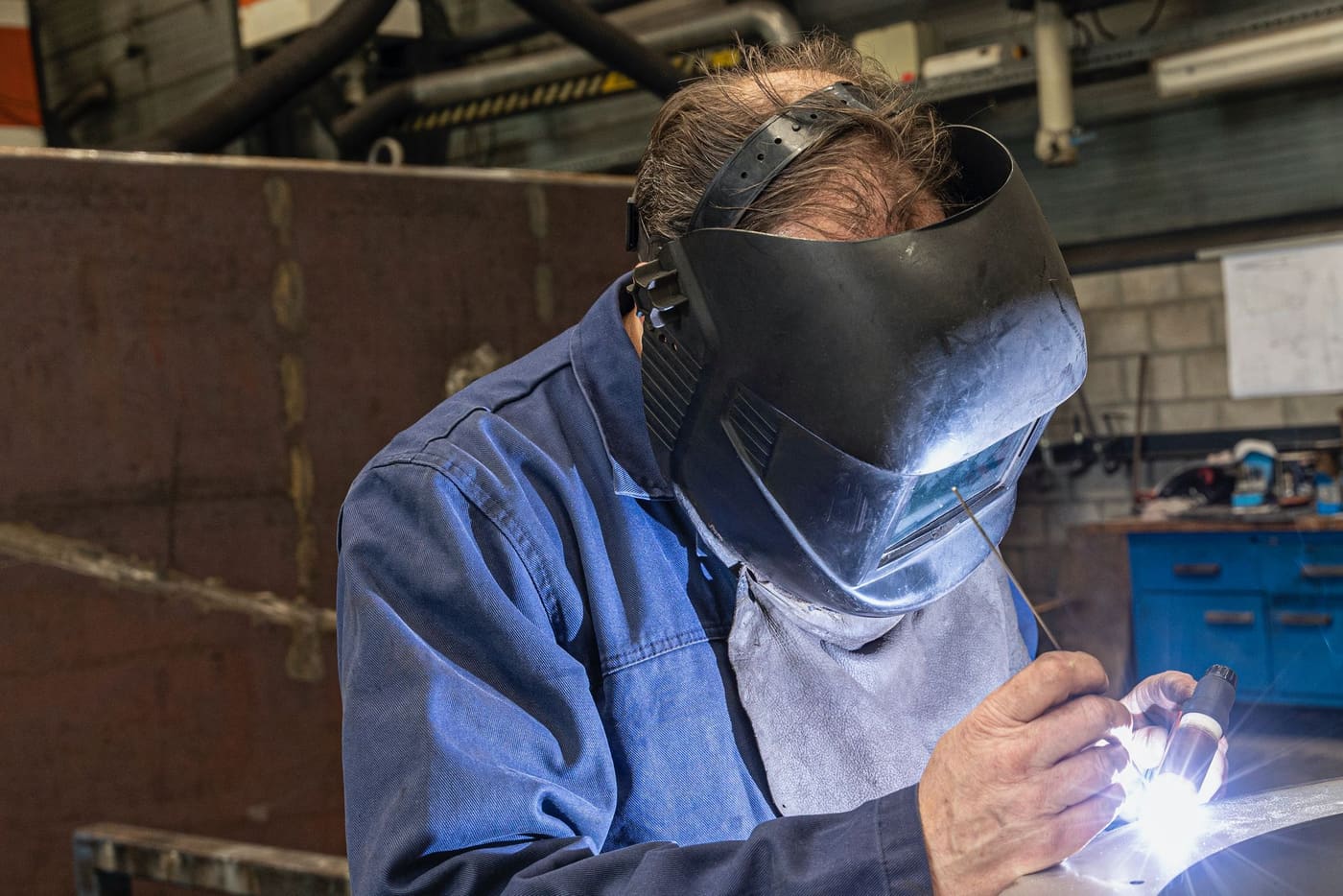
National · Training
TIG Welding Training Courses: How Long They Take, What They Cost and Where to Train
What a TIG welding training course covers in 2026: GTAW certificate length, units, 2024-25 tuition at six colleges and the AWS tests it prepares you for.

National · Training
Welding Apprenticeship Programs: How They Work and How to Get Accepted
How welding apprenticeship programs work in 2026: which union trades train welders, how long they take, what you need to apply and when school comes first.
Illinois · Training
Where to Learn Robotic Welding in Illinois
Eight Illinois colleges teach robotic welding, from Triton's Robotics Welding certificate to Sauk Valley's 5-credit add-on. See what each lists and the pay.
Sources
- Dallas College: Welding programs
- Wiregrass Georgia Technical College Catalog: Gas Metal Arc Welder, TCC
- Mesa Community College: Welding Programs
- Mesa Community College Pathway Map: Welding GMAW/FCAW Certificate of Completion
- College of Lake County: Gas Metal Arc Welding Certificate
- Rowan-Cabarrus Community College Catalog 2026-27: Welding Technology MIG Certificate
- Rowan-Cabarrus Community College: Welding Technology
- AWS: Certified Welder Program
- OSHA Fact Sheet 3647: Controlling Hazardous Fume and Gases during Welding
- NCES College Navigator: Wiregrass Georgia Technical College
- NCES College Navigator: Mesa Community College
- NCES College Navigator: College of Lake County
- NCES College Navigator: Rowan-Cabarrus Community College
- NCES College Navigator: Dallas College